Wednesday, May 19, 2010

Gossip Girl in the Shell, part I


Skinned -and- Crashed
by Robin Wasserman

New York: Simon Pulse, 2008 and 2009


Skinned and Crashed are the first two parts of an intriguing new teen-cyberpunk trilogy by Robin Wasserman, which follows the postmodern cyberpunk identity crisis of a young girl whose life is rapidly destroyed by the technology that saved her in the aftermath of a car crash.

Lia Kahn is the rich, white, blond-haired, blue-eyed ubermadchen daughter of an upper upper class family. Lia goes to the most exclusive school, surrounded by the most exclusive friends, and access to the most exclusive technology available in a story set in a distopian future world still recovering from the horror of nuclear fallout. Lia has everything genetic engineering can provide: perfect looks, perfect mind, perfect life. She and her friends define culture, and walk in luxury.

Like this, but with better wi-fi.

Then the worst happens; Lia's body is destroyed in a freak car crash, forcing her parents to have her mind downloaded into an advanced prosthetic body made to resemble a human being as closely as possible. The story begins with Lia waking up, and follows her through the horror of losing everything she has ever had, and ever been.

In Skinned, Lia and her family are forced to confront the reality of her new situation. Has Lia truly been saved, or is she merely a facsimile of a girl who is now dead? Like all the best stories, the book provides no real answers. In Lia's world, Faith is a quaint concept held only by the delusional, and Lia herself has been raised to believe only in power and will. In fact, she and her family are terrifyingly fascist, and her father has raised her on Nazi slogans; literally, his motto is "work will set you free" - the words written over the gates of Auschwitz.

"Arbeit Macht Frei" = "Work Will Set You Free"

After the accident, Lia's connection with family and friends breaks down in a series of revelations which drive Lia away from her life and into the company of a group of fellow "skinners", other teens who've been downloaded (voluntarily or not) and exist outside of human society.

Some of the themes dealt with in this book are staples of modern cyberpunk and culture. Lia's friends' revulsion is tied to the "not-quite" effect, known as the uncanny valley, in which people are repulsed when confronted by something that very closely resembles a human face, but isn't quite there. This effect is the reason some recent CGI movies and video games haven't fared as well as expected; people just freak out when they see something close (but just not) human.


Feel that chill? That's the Uncanny Valley

As the people around Lia attack or abandon her, Lia herself is forced to deal with the loss of what she has always believed to be "herself". No longer able to "feel" as she once did, Lia experiences a series of emotional responses which are sneakily reminiscent of the Kubler-Ross five stages of grief: denial, anger, bargaining, depression and (ultimately) acceptance. In the process, Lia comes to realize that she no longer belongs in the life she once led. By the end of Skinned, she has literally been stripped bare, and discards the identity of the girl whose life she has failed to replicate.

Monday, May 3, 2010

The Outer Darkness is a Delicacy!

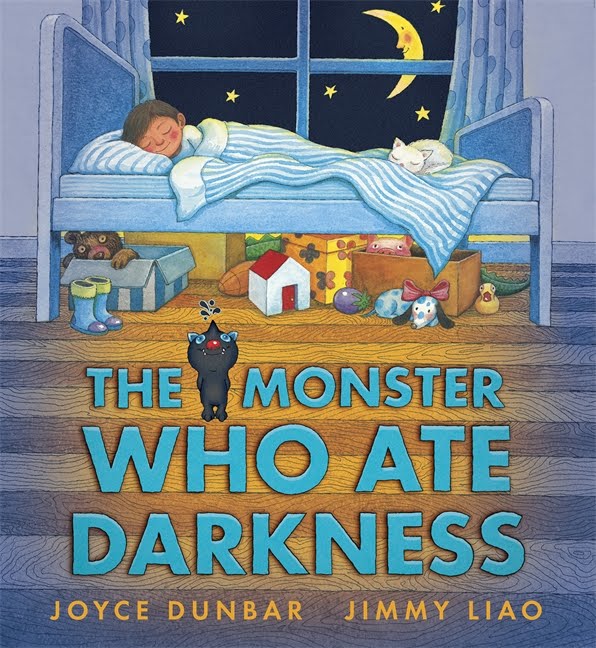
The Monster Who Ate Darkness
by Joyce Dunbar; illustrated by Jimmy Liao
Cambridge, Mass. : Candlewick Press, 2008.

Move over, Shoggoth, here comes... The Monster Who Ate Darkness is a charming tale about a horrible little creature from under a little boy's bed, who eats all of the darkness in the universe, leaving nothing but a wasteland of stark, unforgiving light in its wake. Thankfully, the story has a happy ending, but not until many adorable tears have been shed.

Jo-Jo is terrified of darkness, fearing that there are monsters lurking in the shadows and beneath his bed. Naturally there is one; just a speck of a thing who is cute and cuddly and not at all terrifying when we first meet him. The Monster is hungry, and soon discovers that the only thing that will satisfy his appetite is darkness (note: "darkness sandwiches" = best lunch ever). So he does Jo-Jo a favor, and starts devouring all the darkness in the room.

You got nothin'!

However, his hunger is so immense that he ends up eating all the darkness, everywhere, disrupting the natural order of things and leaving all the animals confused. The monster becomes lonely, lost on a far planet in the stark light of an empty universe, until he hears Jo-Jo weeping in the distance, unable to sleep for lack of darkness. The monster returns to the boy, and holds him, singing him a "darkness lullaby" (which I imagine must sound something like this). As the darkness oozes out of a cone in his head, he shrinks back down as Jo-Jo falls asleep in his arms, until finally the story closes with the boy sleeping with the now-tiny monster nestled in his arms.

This story can be appreciated on a number of psychological levels. For one, it turns nighttime into an adventure; still full of monsters, but comforting in its own way. So, definitely a bedtime story for the kids who don't want to stop believing, but still need a decent night's sleep. The monster isn't evil, just hungry and oblivious, which makes his antics adorable even as he pulls the stars down from the sky. Jo-Jo, meanwhile, restores the natural order of things by embracing his inner darkness (thus, a supervillain is born! haha...). The illustrations are equally enchanting, in many ways telling a story all their own. Artist Jimmy Liao has a talent for drawing the cute with the horrible in the same breath, and the monster is truly a blend of both as he transforms from a kittenish little mite to a bloated monstrosity (also cute), and back again.


A Little Like This...

---

On a side note, I came across this interesting quote from the Q&A section on Joyce Dunbar's website:

"There's also too much cuteness for my liking. I write cute stories myself but this reflects what publishers accept rather than my range as a writer. But this really is a golden age of children's books and you can't expect to publish only the best."

This is part of Dunbar's response to a question about whether she had any complaints as a writer, about publishing and about being a children's author. I personally feel that it speaks to the sort of stories we like to talk about, here at SB/SC; things that break out of the mold, and might be a little frightening, provocative or challenging than what we typically find on the children's shelves of libraries and bookstores, things that are thrilling, and maybe a little more dangerous than cute.

More Dangerous than Cute

The things that make a story compelling are not always things that are comforting, and I worry at times that many of us shy too quickly from introduction our children (or the children around us) to fear in tiny doses. Not that I think we should go around scaring the tuna salad out of toddlers just to see them cry, but an important element in facing fear is the consequential feeling of empowerment we are left with afterwards, once we realize that we have outlived our momentary fear and become stronger for its passing. Children learn more than mere vocabulary from the stories we give them, they learn to live with complexity, ambiguity, distress; and in the end, maybe, they learn to sleep at night by holding the things they were once terrified of closest to their hearts.

PS: If you're looking for more about The Monster Who Ate Darkness, there's a great, thought-provoking review in The New York Times. Enjoy!

Friday, April 9, 2010

Tails, You're It

The Tailypo: A Ghost Story
Told by Joanna C. Galdone
Sandpiper, 1984


Using a misappropriated or a stolen item to build the suspense in a story is a common one in scary books for youth. A character either purposely or unwittingly comes into possession of an item, article, or appendage and the rightful owner of said item, article, or appendage slowly but certainly seeks revenge. Sometimes this revenge is with not so savory results. This storytelling framework is the one employed in a classic children’s scary picture book called The Tailypo: A Ghost Story. Whether or not this is an actual ghost story or just a scary story (for I feel the creature seeking its tail is not necessarily a ghost) can be debated, but nonetheless, this is a smooth and suspenseful tale for young schoolchildren.

The story opens with a lone woodsy cabin. We meet our main character, an elderly man, who lives a hermit-like existence deep in the forest with his three hounds. He lives simply and self-sufficiently. He seems to be a worn out shadow of a once rugged woodsman, the type that is honest, not inclined to superstition, and hearty to the core. After he hears a strange creature in the woods and scratching outside, and eventually in his own cabin, the woodsman strikes out to abolish the creature but instead only cuts off the creature's tail; his tailypo. From this point onward the tale crescendos with the creature calling out in a spooky verse for his tailypo until we fall upon a silent, yet telling scene in the final pages.

The Tailypo is a classic example of a spooky American folktale. The setting, the characters, the tone, and the illustrations are evocative of Appalachia or the Tetons. The rhythm of the tale makes it a great read aloud and storytelling piece. I would venture to guess, since versions of this story have been told for decades, that the first author of this tail didn't see Zombieland. The rules created by Columbus for zombie invasions definitely apply here. Had our woodsman executed rule #4, the doubletap, on our frightening critter instead of just chopping off his tale we would end up with a cheerful woodsman donning a tailypo skin cap and lounging with his hounds instead of an empty cabin and a possibly still at large demonic being roaming the forested mountain range. Well, in any event, it is a delightful little spooky story.

Wednesday, March 10, 2010

Children in the Aftermath

The Pack
by Tom Pow

New Milford, CT: Roaring Brook Press, 2006, ©2004


Tom Pow's The Pack is like a children's primer for Cormac McCarthy. It is a story of desperation and identity, set in a bleak, post apocalyptic setting which is just recognizable enough to be truly disturbing even to veteran fans of the genre. This book occupies a nebulous place between childrens' and young adult literature; though it is ostensibly about children, its themes are somewhat more mature than typical juvenile fiction. Pow's writing style does not coddle his readers, whatever their age, and the subject matter is starker still.

The story in The Pack centers around three feral, orphan children living with wild dogs on the edge of what's left of civilization. The children are named after the storefronts they were found in front of, Bradley, Victor and Floris (the 't' was broken), while the dogs are meaningfully named Hunger, Fearless and Shelter. The pack survives under the tutelage of an old woman, whose stories teach them to retain the last shreds of their humanity. When Floris is kidnapped by a local warlord, the rest are forced into a quest to save her, for their own sakes as well as hers.

There are two reasons that this book is best for advanced readers: one, the story is written in a tone of unflinching brutality, devoid of comfort or ease; two, the literary eloquence of the book, while beautiful, can also be abstract in the extreme, and requires a well-developed sense of reading comprehension. The brutality comes in several forms; one of the crucial turns in the plot centers around a pair of dog fights, described in graphic detail, and several times during the story, characters defend some atrocious behavior by claiming it was necessary to survive.

As for literary abstraction, the main character, Bradley, explicitly follows the form of the Hero's Journey. Though the term itself is never directly invoked, the constant references to stories and dreams (not to mention the narrative style) make it clear that this is the form the pack's movements take. Also, the question of identity is brought into play, as is the barrier between human and animal, boy and girl, civilization and collapse. Finally, there is a level of social commentary which I won't describe in detail, because it is integral to the "big reveal" at the end of the book. Suffice it to say, the Invisible City and its surrounding Zones bear a shocking resemblance to the world as it already is, placed in a smaller sandbox and given a different context.

To what extent the childrens' world is actually "post apocalyptic", in the traditional sense, is never made perfectly clear beyond vague allusions to the "Dead Times". By the end of The Pack, the nature of the world these children live in is less defined than it was at the beginning, and that mystery is part of its charm. In the words of the old woman, repeated as a refrain throughout the book, the world is made of dust and ashes, but stories cannot crumble, burn or be broken.

Tuesday, March 2, 2010

Spaghetti, Squash, and One Hungry Spook

The Ghost of Sifty Sifty Sam
By Angela Shelf Medearis
New York: Scholastic Press, 1997


In this book, as can be the case in scary stories, the spookiest part is the anticipation. We get worried about the suspense and get overwhelmed with fear of what happens next. Or as our character Chef Dan from The Ghost of Sifty Sifty Sam might say, we get caught up in a plot that thickens like standing fatback in a fry pan.

In this story, a brave chef takes up the challenge to spend the night in a haunted house. It is told that in this house lives a horrible ghost and anyone who can spend the night in the house without fleeing will rid the house of the ghost forever. To sweeten the deal, the realtor in charge of the house offers a hefty reward for anyone who can cleanse the property of its supernatural resident. Dan enters the haunted house hopeful and excited, with an armful of groceries to keep him cooking throughout the night.

The storyline builds rhythmically and quickly in this picture book. In the style of short stories like What Do You Come For? and Me Tie Dough-ty Walker! (both short folktales retold by Alvin Schwartz in Scary Stories To Tell in the Dark), the ghost of Sifty Sifty Sam appears piece by piece. With each turn of the page, we see a new incarnation of the spook and a more intense feeling of fear registers with our beloved chef. As we get closer and closer to seeing the entire ghost, the suspense builds and readers wonder what will be Chef Dan’s fate upon meeting the ghost in full form. While the first face-to-face meeting shows a cowering chef and a very intimidating ghost, readers will be surprised by Dan's craftiness as he appeases the spirit and the two forge a friendship in a light-hearted and silly climax.

The watercolor illustrations in this text do a wonderful job of representing the soul of both Chef Dan and Sifty Sifty Sam. Dan is wrapped in warm layers of whites, yellows, browns, and pinks. Sifty Sifty Sam is portrayed with cool blends of blues, whites, grays, and black. Throughout the book you will notice this contrast between the ghost and Chef Dan. This artistic element plays upon the underlying theme of the differences in the realm of the living and the realm of dead. Overall I think this was a fun and quick picture book that would be appropriate to share with children of varying ages.