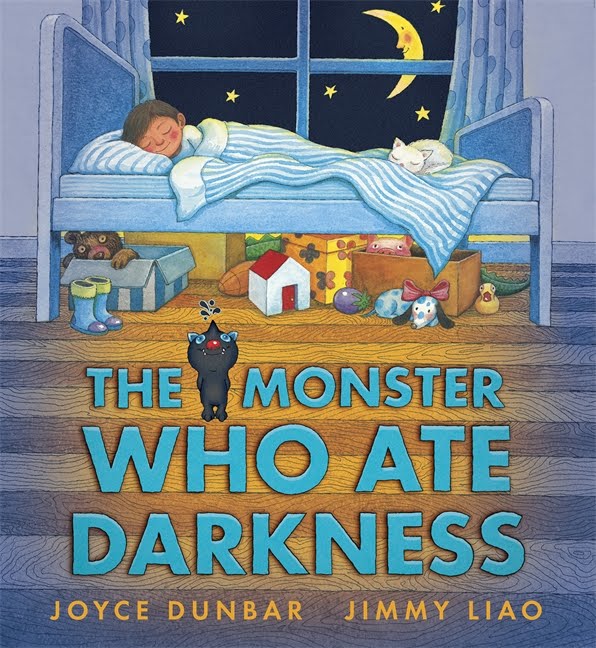
 The Monster Who Ate Darkness
 by Joyce Dunbar; illustrated by Jimmy Liao
Cambridge, Mass. : Candlewick Press, 2008.
Move over, Shoggoth, here comes... The Monster Who Ate Darkness is a charming tale about a horrible little creature from under a little boy's bed, who eats all of the darkness in the universe, leaving nothing but a wasteland of stark, unforgiving light in its wake. Thankfully, the story has a happy ending, but not until many adorable tears have been shed.
Jo-Jo is terrified of darkness, fearing that there are monsters lurking in the shadows and beneath his bed. Naturally there is one; just a speck of a thing who is cute and cuddly and not at all terrifying when we first meet him. The Monster is hungry, and soon discovers that the only thing that will satisfy his appetite is darkness (note: "darkness sandwiches" = best lunch ever). So he does Jo-Jo a favor, and starts devouring all the darkness in the room.
 You got nothin'!
However, his hunger is so immense that he ends up eating all the darkness, everywhere, disrupting the natural order of things and leaving all the animals confused. The monster becomes lonely, lost on a far planet in the stark light of an empty universe, until he hears Jo-Jo weeping in the distance, unable to sleep for lack of darkness. The monster returns to the boy, and holds him, singing him a "darkness lullaby" (which I imagine must sound something like this). As the darkness oozes out of a cone in his head, he shrinks back down as Jo-Jo falls asleep in his arms, until finally the story closes with the boy sleeping with the now-tiny monster nestled in his arms.
This story can be appreciated on a number of psychological levels. For one, it turns nighttime into an adventure; still full of monsters, but comforting in its own way. So, definitely a bedtime story for the kids who don't want to stop believing, but still need a decent night's sleep. The monster isn't evil, just hungry and oblivious, which makes his antics adorable even as he pulls the stars down from the sky. Jo-Jo, meanwhile, restores the natural order of things by embracing his inner darkness (thus, a supervillain is born! haha...). The illustrations are equally enchanting, in many ways telling a story all their own. Artist Jimmy Liao has a talent for drawing the cute with the horrible in the same breath, and the monster is truly a blend of both as he transforms from a kittenish little mite to a bloated monstrosity (also cute), and back again.
 A Little Like This...
On a side note, I came across this interesting quote from the Q&A section on Joyce Dunbar's website:
This is part of Dunbar's response to a question about whether she had any complaints as a writer, about publishing and about being a children's author. I personally feel that it speaks to the sort of stories we like to talk about, here at SB/SC; things that break out of the mold, and might be a little frightening, provocative or challenging than what we typically find on the children's shelves of libraries and bookstores, things that are thrilling, and maybe a little more dangerous than cute.
 More Dangerous than Cute
The things that make a story compelling are not always things that are comforting, and I worry at times that many of us shy too quickly from introduction our children (or the children around us) to fear in tiny doses. Not that I think we should go around scaring the tuna salad out of toddlers just to see them cry, but an important element in facing fear is the consequential feeling of empowerment we are left with afterwards, once we realize that we have outlived our momentary fear and become stronger for its passing. Children learn more than mere vocabulary from the stories we give them, they learn to live with complexity, ambiguity, distress; and in the end, maybe, they learn to sleep at night by holding the things they were once terrified of closest to their hearts.
PS: If you're looking for more about The Monster Who Ate Darkness, there's a great, thought-provoking review in The New York Times. Enjoy!
Move over, Shoggoth, here comes... The Monster Who Ate Darkness is a charming tale about a horrible little creature from under a little boy's bed, who eats all of the darkness in the universe, leaving nothing but a wasteland of stark, unforgiving light in its wake. Thankfully, the story has a happy ending, but not until many adorable tears have been shed.
Jo-Jo is terrified of darkness, fearing that there are monsters lurking in the shadows and beneath his bed. Naturally there is one; just a speck of a thing who is cute and cuddly and not at all terrifying when we first meet him. The Monster is hungry, and soon discovers that the only thing that will satisfy his appetite is darkness (note: "darkness sandwiches" = best lunch ever). So he does Jo-Jo a favor, and starts devouring all the darkness in the room.
 You got nothin'!
 However, his hunger is so immense that he ends up eating all the darkness, everywhere, disrupting the natural order of things and leaving all the animals confused. The monster becomes lonely, lost on a far planet in the stark light of an empty universe, until he hears Jo-Jo weeping in the distance, unable to sleep for lack of darkness. The monster returns to the boy, and holds him, singing him a "darkness lullaby" (which I imagine must sound something like this). As the darkness oozes out of a cone in his head, he shrinks back down as Jo-Jo falls asleep in his arms, until finally the story closes with the boy sleeping with the now-tiny monster nestled in his arms.
This story can be appreciated on a number of psychological levels. For one, it turns nighttime into an adventure; still full of monsters, but comforting in its own way. So, definitely a bedtime story for the kids who don't want to stop believing, but still need a decent night's sleep. The monster isn't evil, just hungry and oblivious, which makes his antics adorable even as he pulls the stars down from the sky. Jo-Jo, meanwhile, restores the natural order of things by embracing his inner darkness (thus, a supervillain is born! haha...). The illustrations are equally enchanting, in many ways telling a story all their own. Artist Jimmy Liao has a talent for drawing the cute with the horrible in the same breath, and the monster is truly a blend of both as he transforms from a kittenish little mite to a bloated monstrosity (also cute), and back again.
 A Little Like This...
---
On a side note, I came across this interesting quote from the Q&A section on Joyce Dunbar's website:
"There's also too much cuteness for my liking. I write cute stories myself but this reflects what publishers accept rather than my range as a writer. But this really is a golden age of children's books and you can't expect to publish only the best."
This is part of Dunbar's response to a question about whether she had any complaints as a writer, about publishing and about being a children's author. I personally feel that it speaks to the sort of stories we like to talk about, here at SB/SC; things that break out of the mold, and might be a little frightening, provocative or challenging than what we typically find on the children's shelves of libraries and bookstores, things that are thrilling, and maybe a little more dangerous than cute.
 More Dangerous than Cute
The things that make a story compelling are not always things that are comforting, and I worry at times that many of us shy too quickly from introduction our children (or the children around us) to fear in tiny doses. Not that I think we should go around scaring the tuna salad out of toddlers just to see them cry, but an important element in facing fear is the consequential feeling of empowerment we are left with afterwards, once we realize that we have outlived our momentary fear and become stronger for its passing. Children learn more than mere vocabulary from the stories we give them, they learn to live with complexity, ambiguity, distress; and in the end, maybe, they learn to sleep at night by holding the things they were once terrified of closest to their hearts.
PS: If you're looking for more about The Monster Who Ate Darkness, there's a great, thought-provoking review in The New York Times. Enjoy!


 Posts
Posts


