Showing posts with label review. Show all posts

Friday, February 25, 2011

Here, Child, Finish Your Nothing

Mirror
by Suzy Lee

New York : Seven Footer Kids, 2003

Mirror, by Suzy Lee, is a very simple, elegant wordless book that, if read properly, will trigger an existential crisis (or philosophical breakthrough) in readers of any age. If your child is too young for Sartre, but old enough to feel the burden of consequence and self-determination, then this is the perfect introduction to instill that lasting sense of angst, guilt and self-doubt.

Despite the austerity of the artwork, there is whimsy in its pages, but by the last page, all such feelings of merriment are dashed. The cover encapsulates this dynamic perfectly; the girl, facing away from her reflection, may have a hint of a smile on her lips, but it never quite reaches her eyes. There is a sense that she is disconnected from herself, perhaps dissatisfied with the stark world in which she has been drawn, even as she plays with her own medium. Of course, this could all be projection...


"We do not know what we want and yet we are responsible for what we are..."


One of the most interesting things about this book is the way the book itself is part of the unspoken narrative. The "mirror" is actually the crease between pages. It is no simple mirror, however, as the girl is not simple reflected in its pages. At one point, the girl mischievously moves into the crease, emerging with her reflection facing in the same direction she is. Of course, we all know what generally happens when little girls walk into mirrors.


"If you are lonely when you're alone, you are in bad company."


In its way, the artwork in Mirror is sweet, and the girl's interactions with her own reflection are the product of playful innocence. Don't be fooled, though. In the last few pages, the girl becomes annoyed with her reflected self, and in a fit manages to push her other, knocking down the mirror (Lee's work here is brilliant, by the way) and shattering it. Spoiler alert: the last page consists of the little girl curled in on herself, and you can almost hear her sobbing into her arms. It came as a shock, I have to admit; though we review horror for children, I have rarely seen a story for kids with such an unrelentingly depressing ending. I have to say, I respect it.

So, if you're ready to crush your child's innocence, or they're already showing a predilection for German expressionism and long-sleeve black turtlenecks, this is a great book. Just know what your child may grow into:


"We are our choices."

Friday, February 11, 2011

Tweaking and Sociopathy for Kids


Little Tricker the Squirrel Meets Big Double the Bear
by Ken Kesey
New York, NY: Viking, 1990.


Finding this book on the shelf at the library was an experience all its own. Take a good look at that cover. Really look at it. Imagine seeing only the top half of it. Those eyes. Those horrible, all-too-human eyes! Those are not the eyes of one of Goldilocks' three bears. Those bears do not hate like this bear hates. This is a stone cold killer, waiting for you to let down your guard. This will not end happily!

Then, after pulling the book off the shelf (the eyes compelled you to), you see the name of the author; yes, yes it is that Ken Kesey. The only person who could write a children's book this bizarre. You know, the same Ken Kesey who wrote One Flew Over the Cuckoo's Nest, and drives around in a real life "Magic School Bus":


"Navigate a nostril... spank a plankton too!"


The inside of the book is every bit as crazy and horrifying as the cover advertises. The bear on the cover is the titular Big Double, a monstrous brute who wanders through the woodland equivalent of a trailer park, eating every one of the creatures he meets, all of whom appear to be destitute and possibly addicted to drugs (at least, that is the effect of Barry Moser's illustrations). Each resident Big Double meets tries to escape him by a challenge of abilities, which the bear matches just before eating them whole. Big Double, by the by, bears a passing resemblance to another famous Ken Kesey character.


Note the Cap...


The protagonist of this story is Little Tricker the squirrel, whose primary redeeming feature is his ability to make a fool out of Big Double. Tricker only seems to have two main motivations: laziness and hunger. Until his meeting with Big Double, his only real struggle is between warring impulses to go get food to store for the winter, or to take a nap. Mostly, the nap wins. Incidentally, Tricker looks very much like he could be on meth-amphetamines, which makes him just about the most realistically depicted squirrel in all of children's literature.

As promised, the story ends awfully. In order to escape, Little Tricker lives up to his name, and tricks Big Double into leaping over the side of a wooded hill, where he then "splatters on the hillside like a thumping ripe melon". Certainly, this book is not meant to be read aloud to kids, right? Except that, like The Talking Eggs, Little Tricker is best enjoyed for its rich and highly accented language, which can only be really appreciated when it's performed.

With all that in mind, I would highly recommend this book for anyone looking to read a good modern variation on the classic trope of little people fending off scary animals. The language is violent in a way that few childrens' stories are, and it takes a certain amount of judgement to decide what the appropriate age is. Take heart, however, because with that glaring cover, it's unlikely any child is going to pick this book up unless they are comfortable with Big Double's gaze in the first place. For that alone, they should be congratulated (and probably feared just a little).

Tuesday, November 23, 2010

Scary Stories Curing Stage Fright?

Scary Readers Theatre
by Suzanne I. Barchers

Libraries Unlimited, 1994

In my days as a children’s librarian and as mentor to early readers I started to come across articles and happen into conversations about Reader’s Theatre. While I’ve heard of the concept before as another mode for actors to express themselves, blocking and performing with scripts instead of memorizing lines, I hadn’t known much about it as a device for education. Looking through listservs I started to see more and more use of reader’s theatre as a way for children to practice reading aloud in a nonthreatening, fun way. Not only that, the concept helps foster reading comprehension, as oftentimes children are given the freedom to take an existing story and adapt it to suit their interpretation or interests. Exercises such as this can help develop strong narrative skills. I think this type of set up can do wonders for the reluctant reader, those wishing to enhance their writing skills (through adapting a story), as well as the shy public speaker. Without the threat of forgetting lines, with encouragement from teachers and librarians, and with plenty of opportunities to practice, get creative, and to explore, I think Reader's Theatre is a positive way to promote literacy among youth.

This being a scary books blog I just had to find out if there were books out there, with an odd or spooky twist, that followed the principles of reader’s theatre. I was looking to see if there was a book that was suitable for school age children and one that gave them opportunities for freedom of expression through writing, creating/adapting scripts, dramatic expression, etc. I couldn’t find anything at my local library but through my university library I found an electronic resource for Scary Readers Theatre by Suzanne I. Barchers. I was stoked to find a scary book that was specifically designed for a reader’s theatre project. This book provided scripted adaptations of 30 popular scary stories, myths, multinational folktales, and urban legends. Due to the methodical nature of the scripts, sometimes the stories seemed a bit dry and unappealing. Hopefully, in such instances, this is where a child could unleash their creativity to save the story by employing an interesting vocal tactic or modifying the flow of the text. This book employed a rating system of scary, scarier, and scariest and it seemed to have a good mix of stories on all levels for elementary and middle school age children. I think this book was a good first find for a reader’s theater piece, especially since it takes away the pressure of script adaptation. In that sense, the work is already done for you. This book is a great start, but I hope there is more out there. If not, we need to make some! These types of books are great to help encourage literacy, with a spooky bent, in schools, libraries, and after-school programs.

Wednesday, October 27, 2010

A Nice Spot of Ink to Cure What Ails You


The Ink Drinker

by Eric Sanvoisen
Illustrated by Martin Matje

Random House Books for Young Readers, 2002

As I’m sure you’ve noticed, the blog has been inactive since summertime. While we all truly love this blog, it is a labor of love that sometimes has to take the backseat to other calls of duty, be they work, school, fighting the zombie invasion, etc. That being said, I just couldn’t let October slip by without a post or two. If there was ever a time for some spooky reading, it has to be October. Here is my first selection to kick off some reading before Halloween!

One thing that I often struggled with when I was working as a Children’s Librarian was getting the reluctant reader to embrace reading. How do you motivate a child that says to you they simply don’t like reading?

After many creative strategies, I think suggesting this book could be another welcome tactic. The Ink Drinker by Eric Sanvoisen is an early chapter book suitable for 8-10 year olds. The tale, originally published in France, is mildly horrible, more bizarre than scary, so it is palatable to a wide audience from those who love vampire tales to those who love silly stories and/or strangeness.

The book begins with a simple and cruel irony. A boy who despises books with a book loving father finds himself stuck in his father’s book shop for the summer. The pain, the sorrow, the agony of being forced to work in a bookstore all summer is more than our protagonist can stand. To pass the time he hides in the shop, daydreams, and people watches. One day he notices a very odd customer. The customer, a pale stranger, practically floating (is he floating?) delicately carries a straw and slips it between the pages of books and slurps. The boy’s horrified gasp causes the stranger to flee. Upon inspection of the volume the stranger held the boy notices that all the pages have been wiped (drank?) clean of any ink, except just a letter or two. Shocked, yet painfully curious, the boy rushes after the stranger into the cemetery where he discovers Draculink, the ink drinking vampire. As the book unfolds the boy finds himself on a journey to explain the mysterious nature of ink drinking. When his father catches him drinking ink the reader realizes just how first-hand the boy’s journey has become.

The quick narrative, the accompanying illustrations, and the elegant strangeness of this tale prove to be strong temptations that would hook any reader. In addition to being a great standalone book, I was happy to learn this title is the first in a full Ink Drinker series. Hopefully this quirky vampire tale can get you in the Halloween spirit. Stay tuned for more upcoming posts!

Friday, July 23, 2010

Social Ghost

The Space Between Trees
by Katie Williams
Chronicle Books
2010

The Space Between Trees by Katie Williams follows the story of a quiet, quirky loner. Evie, a girl raised by her divorced mother, is sixteen with a paper route and every bit the lonely outcast. Awkward in school, not fitting in, she hovers on the periphery observing and fantasizing desired interactions. Her crush, college guy Jonah, seems to be her only source of social hope.

The day that Evie does her paper route near the woods is the same day that Jonah does his job, which is collecting animal carcasses in the woods for animal control. One delivery day Evie is in the wrong place at the wrong time when Jonah discovers a human body in the woods. In a cruel twist, the murdered girl ends up to be Evie’s childhood friend, Elizabeth. It’s a lonely world when not your only friend, but your only former friend, is pulled lifeless from the woods. At the funeral, when Evie lies about the depth of her friendship with Elizabeth, she sets the stage for a very complex dynamic between her, Elizabeth’s father and Elizabeth’s best friend, Hadley. In a strange courtship, Hadley and Evie join forces to discover who the killer is. In a blend of lies, teenage escapades, and frazzled emotions Evie sinks deeper into an increasingly dangerous situation. The story slowly builds to a violent climax, causing Evie to realize what she was after all along.

As it happens, I had very high hopes for this book. The jacket reads like a thrilling murder mystery with an unlikely cast of characters. The book design is a stunning piece of die-cut craftsmanship, very elegant and haunting. The title was intriguing to me, the lonely clearing among massive, strong beings. This space between trees is the growing void of loneliness, isolation, and rejection inside a there-but-never-seen young girl. Evie’s stories, her thoughts, and her hopes stand separately from her bodily action and inaction. Evie is the ghost in the machine, the silent partner to a life unfolding everyway but that which she hoped. A phantasm, alienated from her peers and even those she thinks are friends, in life and in death. Basically, I had to read this book.

As Evie set the tone for her involvement in a devolving situation, so I set myself up for major literary disappointment. The bones of this story have huge potential to take the narrative to a greater place. Unfortunately, I think the story fell short. The author was often telling us how Evie felt instead of writing it so we would experience those feelings with her. As an example, the moment, post climax in the story, where Evie confronts Hadley in the hospital room, should have been an epic scene. Instead, flat observations and a dull dialogue reign in one of the key ending phases of the book. As a reader, I felt cheated. Stories that move us are those that allow us to get swept into and become one with the emotional thread in the story. This book is written in the first-person perspective, so when Evie feels something, anything, I want to feel it through her, organic and natural as she feels it herself. Instead, this story left me with the sense of an out of body experience, like those dreams when you are silently watching yourself from above and outside. I felt very disconnected to this book.

Not seeing the forest for the trees?

Another gripe is the tidy package readers receive at the end of the story. The equivalent of a fairy tale happily ever after, this book takes the easy way out explaining what happens to everyone. The prince married the young maid, they had a dozen babies, had a sprawling mansion by the sea while Evie gains perspective and every major plot point is hastily resolved, the end. I don’t want to create any story spoilers, but I will simply say the last few chapters were a big let down.

While the general theme of this book was on the right track, a coming of age tale, a suspenseful conflict, ultimately, I think this story is forgettable. As far as YA fiction goes, it has many of the key components that make compelling stories but I don’t think these elements were incorporated or utilized to the best effort. I’ve read good reviews for this book and other Katie Williams short stories, but for me The Space Between Trees needed a little more time to grow. Please feel free to read yourself and post opposing viewpoints. I may have been absent in my reading, causing me to miss the essential essence of this story.

Friday, June 4, 2010

Tick Tock, Tick Tock

The House With a Clock in Its Walls
John Bellairs
The Dial Press, 1973
Puffin Books, 1993

The House With a Clock in Its Walls is the first in a glorious and mysterious series by John Bellairs. Having read this book as a child and then recently again as an adult I have to say the gothic bones of this story have allowed it to stand the test of the decades that have passed since it was first published.

The story, along with the whole series, follows the adventures of Lewis Barnavelt. In House the book opens with Lewis moving to the fictional town of New Zebedee, Michigan, more specifically into a sprawling Victorian mansion with his odd yet loveable uncle Jonathan. Overtime, Lewis comes to realize his uncle and his uncle’s friend Florence Zimmerman dabble in the dark arts; Jonathan a fledgling wizard and Florence a powerful yet cautious witch. As if being bathed in the spectacle of magic mirrors, light-hearted displays of illusion, and wizardry wasn’t fascinating enough, Lewis is quickly confronted with the evil side of such powers when he learns about the previous owners of the house, the cunning and sinister Isaac and Selenna Izard. Before his death, the power hungry (criminally insane?) Isaac constructed a hidden enchanted clock within the walls of the New Zebedee home. The device, meant to align the cosmos in such a way to allow Izard’s magic to obliterate the world, eternally ticks in an attempt to carry out Izard’s evil plan, even from beyond the grave. The story builds and an escalating series of ghostly encounters climaxes into a stunning finish which will encourage readers on to the next book in the series.

The glory of this story rests not only in the wonderful writing and the supernatural/magical elements of the plot, but also in the quiet and relatable nature of the characters. Lewis Barnavelt, who is perhaps like his maker John Bellairs and countless others, is a self-conscious yet curious boy, eager to find friends, but more comfortable reading and crunching cookies. Oft being the last boy picked for the baseball team, if picked at all, can lead to an overpowering sense of desperation which is all too human. Unfortunately, it is such desperation which often leads to horrifying results, particularly in a supernatural type book. One of the threads of the story follows Lewis as he befriends, struggles to keep, and ultimately loses his friend Tarby. When we see Lewis try to raise the dead in the cemetery to impress Tarby we feel his overwhelming sense of loneliness, knowing that whether or not his incantation works, he’s probably lost Tarby anyway. I think seeing Lewis vulnerable and exposed, stripped bare spiritually, allows us to really see Lewis. Being so close to him makes this story even greater than it already is.


As if I couldn’t love this book enough, the illustrations are masterfully created by the late Edward Gorey. In true Gorey style, the character of his illustrations, which he self-described as literary nonsense (the class of such as Lewis Carroll), fit perfectly with the tone of the story. Dark, mysterious, subtle yet awful (in imagery, not construct) the pictures in this book are so breathtakingly beautiful that it further accentuates what a wonderful literary gift this book, and series, is to readers of all ages. I highly recommend this book for middle grade readers, and even teens and adults who want another chance to solve the mysteries of their youth and visit the haunts of their childhood. We all have them, I’m quite sure.

Wednesday, May 19, 2010

Gossip Girl in the Shell, part I


Skinned -and- Crashed
by Robin Wasserman

New York: Simon Pulse, 2008 and 2009


Skinned and Crashed are the first two parts of an intriguing new teen-cyberpunk trilogy by Robin Wasserman, which follows the postmodern cyberpunk identity crisis of a young girl whose life is rapidly destroyed by the technology that saved her in the aftermath of a car crash.

Lia Kahn is the rich, white, blond-haired, blue-eyed ubermadchen daughter of an upper upper class family. Lia goes to the most exclusive school, surrounded by the most exclusive friends, and access to the most exclusive technology available in a story set in a distopian future world still recovering from the horror of nuclear fallout. Lia has everything genetic engineering can provide: perfect looks, perfect mind, perfect life. She and her friends define culture, and walk in luxury.

Like this, but with better wi-fi.

Then the worst happens; Lia's body is destroyed in a freak car crash, forcing her parents to have her mind downloaded into an advanced prosthetic body made to resemble a human being as closely as possible. The story begins with Lia waking up, and follows her through the horror of losing everything she has ever had, and ever been.

In Skinned, Lia and her family are forced to confront the reality of her new situation. Has Lia truly been saved, or is she merely a facsimile of a girl who is now dead? Like all the best stories, the book provides no real answers. In Lia's world, Faith is a quaint concept held only by the delusional, and Lia herself has been raised to believe only in power and will. In fact, she and her family are terrifyingly fascist, and her father has raised her on Nazi slogans; literally, his motto is "work will set you free" - the words written over the gates of Auschwitz.

"Arbeit Macht Frei" = "Work Will Set You Free"

After the accident, Lia's connection with family and friends breaks down in a series of revelations which drive Lia away from her life and into the company of a group of fellow "skinners", other teens who've been downloaded (voluntarily or not) and exist outside of human society.

Some of the themes dealt with in this book are staples of modern cyberpunk and culture. Lia's friends' revulsion is tied to the "not-quite" effect, known as the uncanny valley, in which people are repulsed when confronted by something that very closely resembles a human face, but isn't quite there. This effect is the reason some recent CGI movies and video games haven't fared as well as expected; people just freak out when they see something close (but just not) human.


Feel that chill? That's the Uncanny Valley

As the people around Lia attack or abandon her, Lia herself is forced to deal with the loss of what she has always believed to be "herself". No longer able to "feel" as she once did, Lia experiences a series of emotional responses which are sneakily reminiscent of the Kubler-Ross five stages of grief: denial, anger, bargaining, depression and (ultimately) acceptance. In the process, Lia comes to realize that she no longer belongs in the life she once led. By the end of Skinned, she has literally been stripped bare, and discards the identity of the girl whose life she has failed to replicate.

Monday, May 3, 2010

The Outer Darkness is a Delicacy!

The Monster Who Ate Darkness
by Joyce Dunbar; illustrated by Jimmy Liao
Cambridge, Mass. : Candlewick Press, 2008.

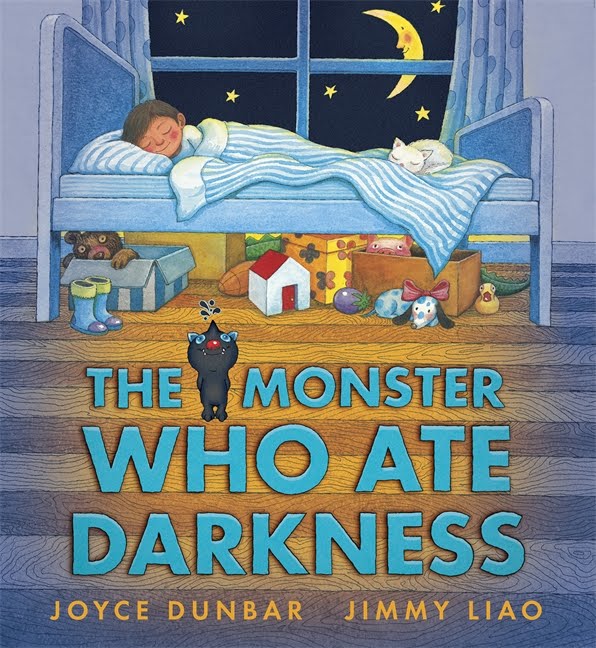
Move over, Shoggoth, here comes... The Monster Who Ate Darkness is a charming tale about a horrible little creature from under a little boy's bed, who eats all of the darkness in the universe, leaving nothing but a wasteland of stark, unforgiving light in its wake. Thankfully, the story has a happy ending, but not until many adorable tears have been shed.

Jo-Jo is terrified of darkness, fearing that there are monsters lurking in the shadows and beneath his bed. Naturally there is one; just a speck of a thing who is cute and cuddly and not at all terrifying when we first meet him. The Monster is hungry, and soon discovers that the only thing that will satisfy his appetite is darkness (note: "darkness sandwiches" = best lunch ever). So he does Jo-Jo a favor, and starts devouring all the darkness in the room.

You got nothin'!

However, his hunger is so immense that he ends up eating all the darkness, everywhere, disrupting the natural order of things and leaving all the animals confused. The monster becomes lonely, lost on a far planet in the stark light of an empty universe, until he hears Jo-Jo weeping in the distance, unable to sleep for lack of darkness. The monster returns to the boy, and holds him, singing him a "darkness lullaby" (which I imagine must sound something like this). As the darkness oozes out of a cone in his head, he shrinks back down as Jo-Jo falls asleep in his arms, until finally the story closes with the boy sleeping with the now-tiny monster nestled in his arms.

This story can be appreciated on a number of psychological levels. For one, it turns nighttime into an adventure; still full of monsters, but comforting in its own way. So, definitely a bedtime story for the kids who don't want to stop believing, but still need a decent night's sleep. The monster isn't evil, just hungry and oblivious, which makes his antics adorable even as he pulls the stars down from the sky. Jo-Jo, meanwhile, restores the natural order of things by embracing his inner darkness (thus, a supervillain is born! haha...). The illustrations are equally enchanting, in many ways telling a story all their own. Artist Jimmy Liao has a talent for drawing the cute with the horrible in the same breath, and the monster is truly a blend of both as he transforms from a kittenish little mite to a bloated monstrosity (also cute), and back again.


A Little Like This...

---

On a side note, I came across this interesting quote from the Q&A section on Joyce Dunbar's website:

"There's also too much cuteness for my liking. I write cute stories myself but this reflects what publishers accept rather than my range as a writer. But this really is a golden age of children's books and you can't expect to publish only the best."

This is part of Dunbar's response to a question about whether she had any complaints as a writer, about publishing and about being a children's author. I personally feel that it speaks to the sort of stories we like to talk about, here at SB/SC; things that break out of the mold, and might be a little frightening, provocative or challenging than what we typically find on the children's shelves of libraries and bookstores, things that are thrilling, and maybe a little more dangerous than cute.

More Dangerous than Cute

The things that make a story compelling are not always things that are comforting, and I worry at times that many of us shy too quickly from introduction our children (or the children around us) to fear in tiny doses. Not that I think we should go around scaring the tuna salad out of toddlers just to see them cry, but an important element in facing fear is the consequential feeling of empowerment we are left with afterwards, once we realize that we have outlived our momentary fear and become stronger for its passing. Children learn more than mere vocabulary from the stories we give them, they learn to live with complexity, ambiguity, distress; and in the end, maybe, they learn to sleep at night by holding the things they were once terrified of closest to their hearts.

PS: If you're looking for more about The Monster Who Ate Darkness, there's a great, thought-provoking review in The New York Times. Enjoy!